


 In my recent Earthen Vessels article on the books I’ve been reading lately, I made mention of the recently published festschrift, He Opened to Us the Scriptures: Essays in Honor of Arthur A. Just Jr., edited by Charles A. Gieschen (CPH 2026). Dr. Gieschen kindly afforded me the privilege of crafting a brief opening “biography” for that volume, but my interest in the book with its impressive collection of scholarly essays goes far beyond my own small part. Kudos to the editor, not only for pulling everything together so beautifully, but also for the way he has presented the festschrift to the Church. It was first announced this past spring, and from what I understand it was an absolute and utter surprise to Dr. Just at that time. I was disappointed to be out of town and unable to attend that public announcement, so I was very pleased to be on hand for a formal presentation of the book by the editor and contributors at a Seminary convocation this past week. In a room packed with students, faculty, and staff, thirteen of the twenty essayists were able to share brief descriptions of their respective contributions, along with their appreciation for – and their congratulations to – their friend and colleague, Dr. Arthur Just.
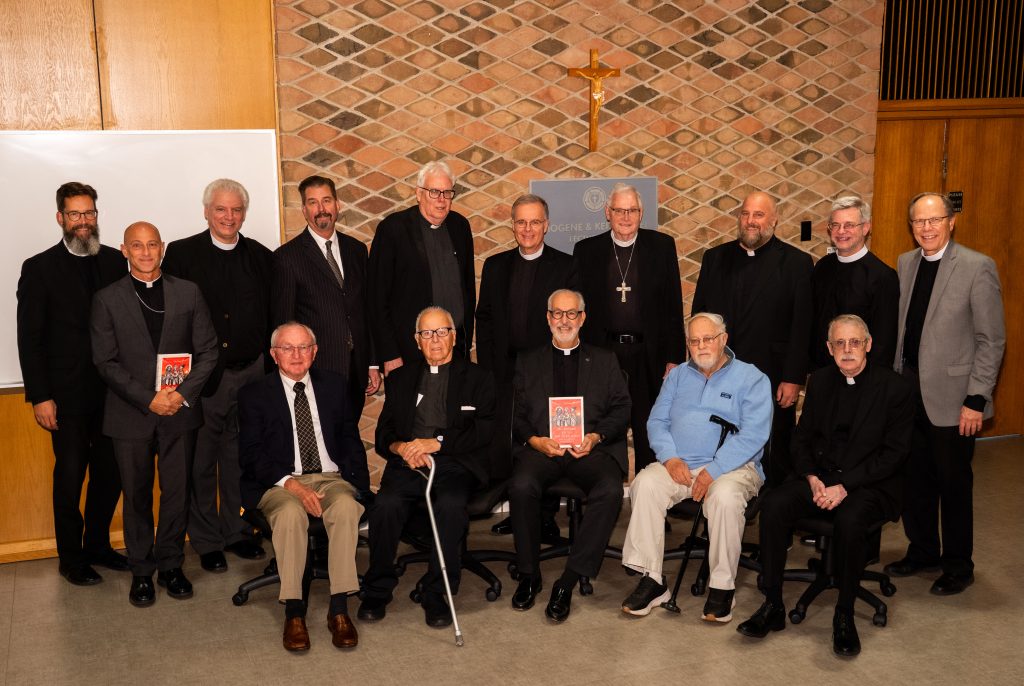
Rev. Dr. Arthur Just (seated center) with several essayists at the formal presentation of a festschrift in his honor
The convocation was a moving experience, poignant and nostalgic in many ways. Simply considering the men who wrote for the festschrift – not only the thirteen essayists who were able to attend, but another seven scholars from around the world who could not be there – demonstrates the weighty significance and extent of Dr. Just’s contributions to the theology and life of the Church on earth. More than that, the scope of the essays appropriately echoes and reflects the breadth of his work over the past forty+ years. The volume is divided into several sections, comprehending “The Scriptures of the Church,” “The Worship of the Church,” and “The Mission of the Church,” the very areas for which Dr. Just has labored. I look forward to working my way through each and all of the essays over the coming weeks and months as they continue the tradition of “opening the Scriptures” and leading us to the Breaking of the Bread.
My wife LaRena and I were seated at the same table with Dr. Just and his wife, Linda, at the opening dinner for new students when I began my seminary studies in the fall of 1989. That my acquaintance with this man who has since been my teacher, my mentor, my colleague, and my friend, began with such table fellowship has struck me as especially delightful and apropos; for he has taught me as much as anyone the significance of table fellowship in general, and of table fellowship with Jesus in particular. I had all three of my homiletics courses with Dr. Just, so I credit him for teaching me how to preach. But hearing him preach in chapel, attending his lectures and presentations at various conferences, serving as his grader for a year, reading his books and essays, especially his Commentary on St. Luke, and working closely with him on the Lectionary Committee of the LSB project from 1998 through 2006 – all taught me so much more than I am even able to comprehend. As I said in my brief remarks at the convocation, I would not be the pastor and theologian I am today apart from Dr. Just and his instruction and influence.
Aside from all that, I was profoundly moved by yet another aspect of the convocation this past week. As surely as it is true that I owe such a debt of gratitude to Dr. Just, so it is that I likewise owe similar debts to several of his colleagues who contributed to the festschrift. It will come as no surprise to anyone who knows me that Dr. David P. Scaer and Dr. William C. Weinrich were certainly among my most formative professors, and to this day I regard them both with such deep affection, admiration, and appreciation. They were already seasoned professors at the Seminary when Dr. Just began, having had him as a student before he joined them on the faculty as a colleague. I have marveled at the fact that Dr. Weinrich had my Dad as a student, myself as a student, and most recently my son Zach as a student. Other essayists have been colleagues and peers with Dr. Just for many years, still others have been his students, much like myself, and among those men are some whom I have known as younger colleagues. The panoply of presenters at the convocation thus set before us a picture of that great tradition of the faith once delivered to the saints, handed over from generation to generation from spiritual fathers to spiritual sons, for the care and catechesis of our children and our children’s children, unto the close of the age. It is thirty-seven years since I started at the Seminary and first met Dr. Just, and last week I was blessed to behold at once several generations of the fruit our Lord has borne through him and others.